Catalan amphorae (CAT AM)
Two samples
General appearance
This fabric is distinctively red-brown (5YR 5/4–5/6) to red (10R 5/8–4/8) throughout, with surfaces
slightly lighter or duller in the same tones (5YR 5/6–5/8, 10R 5/6). It is very hard with harsh surfaces
and hackly fracture. In Britain, Peacock & Williams Class 10 (Dressel 2–4) most commonly occurs in this
fabric, although the earlier Peacock & Williams Class 6 (Pascual 1) was also made.
Hand specimen
Typically this fabric has ill-sorted grains ranging between 0.1–3.0mm, but normally not exceeding 2.0mm.
Quartz and feldspar are common, as are light-coloured composite rock fragments and gold mica (<0.5mm),
the latter of which appears sparse in fracture but common on the surface (<1.5mm). One sample (not
examined in thin section) contains common granular black accessory minerals (0.3–1.0mm) and possibly some
silver mica.
Thin section
The sample comprises common to abundant ill-sorted subangular fine to very coarse sand, which consists
predominantly of altered alkali feldspar and quartz, with sparse biotite and plutonic rock fragments. Rare
amphibole (up to 0.4mm), epidote and fine-grained calcite up to 0.2mm are also present. Sparse silt-grade
material consists mainly of quartz.
Source
Kilns are known along the Catalan coast, concentrating in the area of Barcelona (Peacock & Williams
1986, 93).
Donor
Museum of London
Museums
Museo Municipal Plaza del Obispo, Badalona (Spain)
References
Beltrán Lloris, M, 1970 Las ánforas romanas en España, Zaragoza
Calvo, V R, & Carreras Monfort, C, 1993 El vino de la Tarraconense en Britannia, Münsterische Beiträge zur antiken Handelsgeschichte 12, 53–92
Carreté, J-M, Keay, S, & Millett, M, 1995 A Roman provincial capital and its hinterland. The survey of the territory of Tarragona, Spain, 1985–1990, J Roman Archaeol Suppl 15, Ann Arbor
Corsi-Sciallano, M, & Liou, B, 1985 Les épaves de Tarraconaise à chargement d’amphores Dressel 2–4, Archaeonautica 5
Keay, S J, & Jones, L, 1982 Differentiation of early Imperial amphora production in Hispania Tarraconensis, in Current research in ceramics: thin section studies (eds I Freestone, C Johns & T Potter), British Museum Occ Pap 32, 45–61
Miró, J, 1989 La producción de ánforas romanas en Catalunya. Un estudio sobre el comercio del vino de la Tarraconese (siglos I aC–I dC), BAR Suppl Ser 473
Pascual Gausch, R, 1962 Centros de produccion y diffusion geographica de un tipo de anfora, VIIe Congreso Nacional de Arqueologia, 334–45, Zaragoza
Pascual Gausch, R, 1977 Las anforas de la Layetania, in Méthodes classiques et méthodes formelles dans l’étude des amphores, Collection de l’Ecole Française de Rome 32, 47–96, Rome
Sealey, P R, 1985 Amphoras from the 1970 excavations at Colchester Sheepen, BAR 142
Tchernia, A, & Zevi, F, 1972 Amphores vinaires de Campanie et de Tarraconaise à Ostia, in Recherches sur les amphores romaines, Collection de l’Ecole Française de Rome 10, 35–67, Rome
Williams, D F, 1981 The Roman amphora trade with late Iron Age Britain, in Production and distribution: a ceramic viewpoint (eds H Howard & E L Morris), BAR Int Ser 120, 123–32
See the related record on the Atlas of Roman Pottery on the Potsherd website

Plate 67: Fresh sherd break of CAT AM (width of field 24 mm)
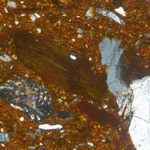
Plate 67.1: Photomicrograph of CAT AM (XPL) (width of field 1.74 mm)
<< Campanian Fabrics
::
Fishbourne 148.3 amphorae >>
 SGRP home page