Moselkeramik Black-slipped ware (MOS BS)
Five samples
General appearance
This fabric is generally orange-brown (2.5YR 5/6–5/8) or red (10R 5/8) with a grey core or margins,
these colours being sandwiched together in thin, well defined layers. It is hard with a conchoidal fracture
and a smooth feel. The slip is smooth, even and glossy with, in many cases, a metallic sheen. In most cases
it is not quite completely black, being rather a very dark, slightly green-brown (5Y 2.5/2). A wide range
of beakers was produced, but typical forms are folded and rouletted beakers, or occasionally those
decorated with barbotine comprising white pipeclay.
Hand specimen
A fine fabric, generally with inclusions <0.1mm (although rarely to 0.4mm) and a fused matrix.
Limestone is consistently abundant, while black iron-rich grains and silver mica may be common; quartz is
invariably sparse. It has a characteristically speckled appearance, caused by the quantities of very fine
limestone in the clay. Although mica can be identified in the clay, in comparison to
Central Gaulish Black-slipped ware the fabric is characterised by the
lack of mica.
Thin section
In thin section this is a fine calcareous clay, containing common silt-grade quartz and limestone. The
inclusions are ill sorted, with common limestone, frequently to
c 0.15mm although up to
c 0.3mm; other inclusions, graded as the limestone, are sparse opaques and rare clay pellets and
quartz. Sparse muscovite mica is clearly visible.
Source
Trier appears to have been the main source for these wares, although the unpublished production centre
at Kasden (Cochem-Zell, Germany) may have been a secondary source (Vilvorder 1999).
Donor
Museum of London
Museums
Corbridge Roman Site Museum; Department of Prehistoric & Romano-British Antiquities, The British
Museum; Museum of London; Römische-Germanisches Museum, Cologne (Germany); Rheinische Landesmuseum, Trier
(Germany)
References
Blaszkiewicz, P, & Dufournier, D, 1987 Caractérisation et diffusion du ‘gobelet sac’ en Normandie, du milieu du Ier à la fin du IIe siècle, SFECAG. Actes du Congrès de Caen, 75–80
Bocquet, A, Laduron, D, & Vilvorder, F, 1992 Carte d’identité physico-chimique des céramiques fines engobées produites dans les ateliers de Cologne et de Trèves, SFECAG. Actes du Congrès de Tournai, 223–37
Greene, K, 1978c Roman trade between Britain and the Rhine provinces: the evidence of the pottery to AD 250, in Roman shipping and trade: Britain and the Rhine provinces (eds J du Plat Taylor & H Cleere), CBA Res Rep 23, 52–8
Richardson, B, 1986 The waterfront group: coarsewares and non-samian finewares, in The Roman quay at St Magnus House, London. Excavations at New Fresh Wharf, Lower Thames Street, London 1974–1978 (L Miller, J Schofield & M Rhodes), London Middlesex Archaeol Soc Spec Pap 8, 106–38
Symonds, R P, 1992 Rhenish wares. Fine dark coloured pottery from Gaul and Germany, Oxford Univ Comm Archaeol Monogr 23
Vilvorder, F, 1999 Les productions de céramiques engobées et métallescentes dans l’est de la France, la Rhénanie et de la rive droite du Rhon, in Céramiques engobées et métallescentes gallo-romaines (eds R Brulet, R P Symonds & F Vilvorder), RCRF Acta Suppl. 8, 69-122
See the related record on the Atlas of Roman Pottery on the Potsherd website

Plate 43: Fresh sherd break of MOS BS (width of field 24 mm)
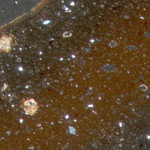
Plate 43.1: Photomicrograph of MOS BS (XPL) (width of field 1.74 mm)
<< Lyon Colour-coated ware
::
North African Red-slipped ware >>
 SGRP home page