Peacock & Williams No 66 amphorae (P&W AM 66)
Single sample
This type is also known as the ‘Kingsholm 117’ amphora.
General appearance
The type sherd is brown (5Y 5/4) with orange-brown (5YR 6/6) margins and pale brown (5YR 6/4) surfaces.
It is a hard, harsh fabric with irregular break. The entire body is ribbed, and it is distinguished from
Peacock & Williams Class 12 by its wide body girth.
Hand specimen
Our sample is characterised by well-sorted inclusions of abundant quartz and common limestone
(0.1–0.3mm, occasionally to 0.5mm), with sparse shell fragments (to 2.0mm). Other sparse inclusions are
rounded organic voids, red-brown or red iron-rich fragments and clay pellets, the latter up to 0.9mm.
Thin section
This is a well-sorted fabric containing common quartz, normally measuring <0.15–0.2mm, set in a clean
but very slightly silty, calcareous matrix. Silt-grade limestone is common, while larger grains are common
although second in quantity to the quartz. Also present are feldspar, microfossils, ferrogmagnesian
accessory minerals and a single basic volcanic rock (0.5mm). Clay pellets (some quartz free) are common,
usually <0.5mm, as are smaller opaque fragments.
Source
In both style and fabric it is similar to
Peacock & Williams Class 12, and they may share a common
origin.
Donor
Museum of London
Museum
City Museum and Art Gallery, Gloucester
References
Sealey, P R, 1985 Amphoras from the 1970 excavations at Colchester Sheepen, BAR 142
Timby, J R, 1985 Amphorae, in Kingsholm. Excavations at Kingsholm Close and other sites with a discussion of the archaeology of the area (H R Hurst), Gloucester Archaeol Rep 1, 72–6
See the related record on the Atlas of Roman Pottery on the Potsherd website

Plate 86: Fresh sherd break of P&W AM 66 (width of field 24 mm)
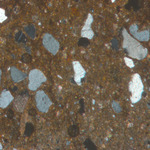
Plate 86.1: Photomicrograph of P&W AM 66 (XPL) (width of field 1.74 mm)
<< Peacock & Williams Class 50 amphorae
::
Rhodian Fabrics >>
 SGRP home page